
I’ve heard before how children interact with the world can change someone’s perspective, but I never expected to see a sensory toy become a new way to approach circular economy and carbon capture and sequestration.
Let me explain what I mean by painting a picture.
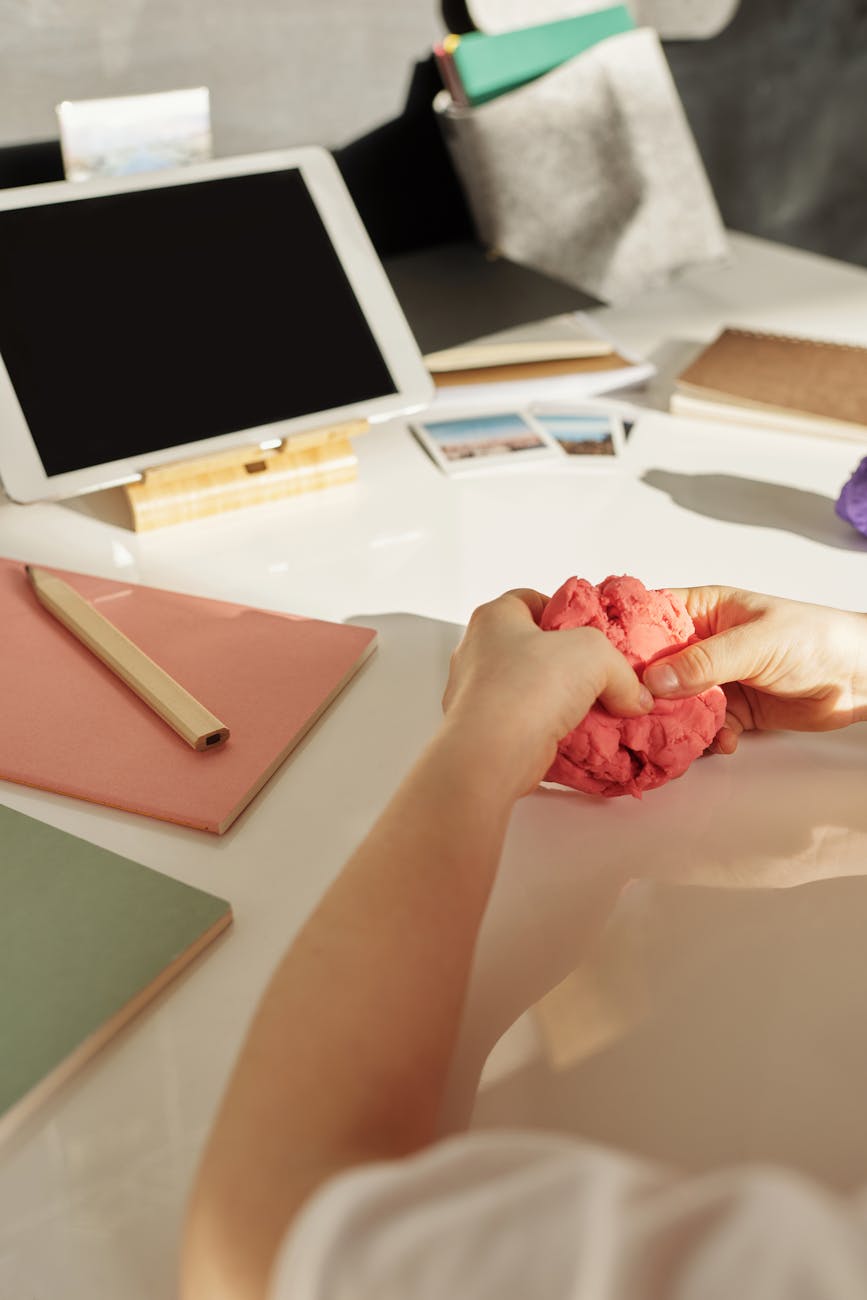
Billy and Cat sit at the same group of desks. Both happen to enjoy playing with kinetic sand when they are given the chance. Sure things might get a little messy, but they make sure to clean up the large pieces. They clean their desks and get back to their day, maybe occasionally finding little bits of sand long after the box is put away.
The one afternoon becomes a week. Sand slowly trickles under papers, onto the ground, perhaps into bins until enough of that kinetic sand is a little ball once again. That little, precious ball is placed carefully into a pencil case, added to carefully over the next week or so. Eventually that small ball becomes the size of an eraser.
This sand waste is no longer trash, it is in fact, treasure. So precious that Billy and Cat begin to eye the other’s stash. Unbeknownst to anyone else, they begin their trades. Billy wants some of Cat’s brown sand, and Cat wants some of the purple sand one day. They surreptitiously converse over pencil cases, build deals in crayon and pencil shavings. The following week, they may enjoy the results of this, happy to modify their hidden fidget toy. And as long as one of them has the means or another stash growing, then they can continue to make that trade for as long as possible.
Then Came the Observer
Alas, someone had to be the party pooper. And that person was unfortunately me. From one comment, I began to realize the racket the two were running and brought it to a halt. And what a tragedy it was to the floor sand economy. No more clumps were allowed to stay on the floor or pencil cases, it all went into the trash.
But the memory has lingered far too long in my head. Honestly, I could have spent an entire year watching the entire process. What would happen in the pencil case fidget got to big? Would they carve out dirty parts to add cleaner ones? Would they store them in bins? Who else could have been part of the racket if it was allowed to grow? What else would they trade for a nice little clump of blue or maybe yellow sand? Would Kat offer any good crayons or part of her snack? What were the rules of their corner of the world?
This is a beautiful example of how waste and resource, debris and treasure are all dependent on the eye of the observer. These kids prized every weird clump of kinetic sand, thus creating worth. What have I prized that others ignored, where have I created worth?
Better yet: where have our societies and economies created worth and waste, and how can we change our relationships with materials and our consumption of goods?
Waste as Resource, Not a Burden
Two modern problems came to mind because of the rabbit hole I was on at the time: circular economy and climate change. Both of which seemed to be looking at waste in a different light, especially in the controversial science of carbon capture and sequestration (or CCS).
Keep in mind I’m just as fluent in these subjects like a kid in elementary school, however I believe that approaching them with a curious and open mind can spur on interest and, more importantly, crucial conversations.
Firstly, CCS is a method of capturing CO2 to put it in the ground, about a mile or so. It is favored by companies that are oil and fossil fuel orientated. There are concerns about how the sequestration would interact with underwater aquifers, therefore the quality of green water (water in ground).
My concerns here are about the end result. How much carbon can we realistically capture? Is it okay to have these, and what happens when its full or if we abandon them? What if it becomes a shell game for oil industry to move money around, and who will be the one to watch and regulate that? And what if the carbon can be used in a different way, other than to be thrown back into the earth?
Let’s say someone wanted to start their mushroom bin farm which captures an x amount of carbon. That carbon is not simply a waste, it becomes a resource for that start up company. I would like to explore more of what can safely consume the CO2 as a natural resource, without further destroying the precious balance we’ve been fighting to protect. We should be supporting more innovative ways to use this abundant resource while we still have the chance, and still be making changes to prevent this devastation again.
Which then leads to the next point of circular economy. This is basically restructuring economy in the cycle of birth to death of a product; for every bit of material, wiring, device life and radioactive life. The idea is about mindful creation while (hopefully) minimizing the ecological and other impacts along the way. Then by following this process and building markets that follow this path, we can build a stable economy that generates from natural ends and starts.
However products can live a lot longer, thereby increasing the value of the piece to both producer and consumer when they go through processes of reuse, recycling, and reprocessing. This looks like old curtains being turned into bags; newspapers as garden liners; and melting down stripped screws into a new rod for doll house pins. The lives of products can go far beyond than expected if we are open to learn how to create value out of things we deem as waste when we feel “done” with them.
Intuition as Teacher Within Chaos
These kids were bypassing the use-discard cycle in a wonderfully chaotic and natural way they could think. They upcycled! Billy and Cat recognized that they were creating an excess of something that adults saw as waste. Scattered sand was undesired, meant to be tossed away and forgotten. Yet it wasn’t cleaned up, then it would be a disruption to the classroom. Sensory boxes would be closely regulated, if not entirely taken away, thus effecting the entire climate of the class.
These two intuitively recognized the sand on the floor was, indeed, valuable. In fact, that together they recognized the worth of multi-colored sands they could save for fidgets, then eventually trade.
So why is it so difficult for adults, businesses and governments to recognize and change to the current reality of produce and waste? I believe that the greatest innovators are, in fact, the youngest, poorest and creative of all of us. Change does not come from heads of state or old personal habits passed from generation to generation. We are looking in the wrong direction because we are trying so hard to look cool and in charge to other older people.
Let’s finally scrap the old destructive habits that brought us to this climate calamity, and lean into a more intuitive and resourceful approach to waste. Let’s bring some life and levity back into our perspective in observance of the fallen Floor Sand Economy. As much as I had to end the school room racket, I also very much miss the mystery of observing an intricate and thorough process of finding perfect loopholes.
Till next time, my dears!
 Enchantress Morgan's Domain